Now shipping nationwide • Free guides & recipes

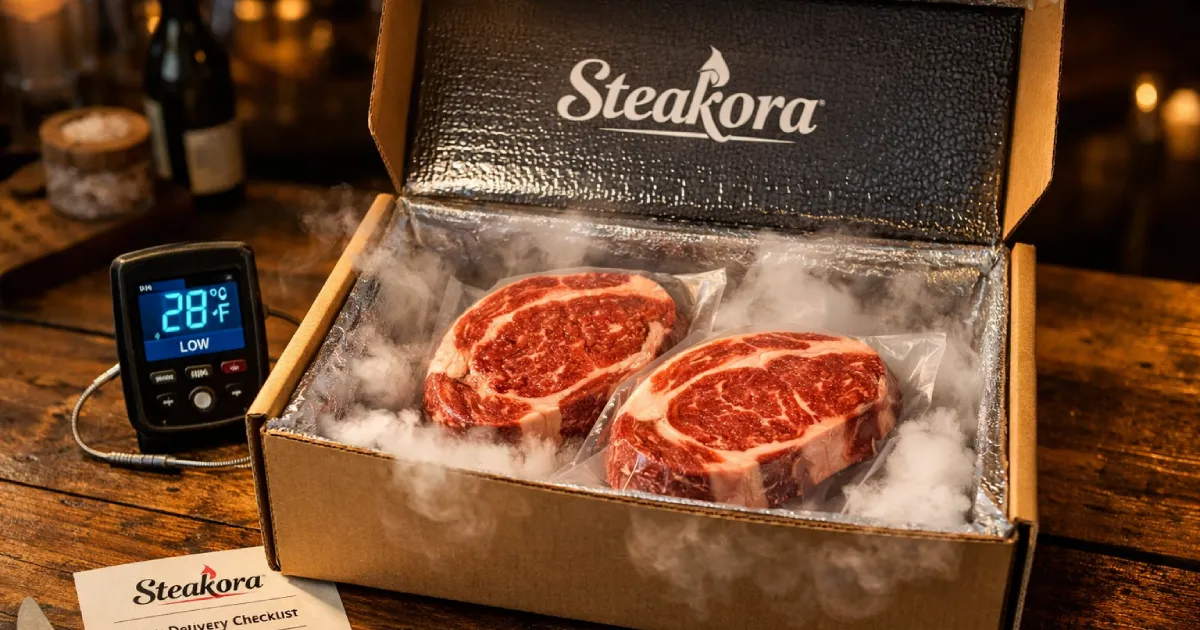
How to Buy Steak Online
Don't settle for sub-par beef. Our 2026 guide covers the essential checklist for buying steak online, including smart-label tracking, sustainable packaging, and the "Gold Standard" thawing methods.

Buying steak online used to be a “nice-to-have” convenience—something you did for a holiday rib roast or a last-minute gift. In 2026, it’s become the fastest way to access better beef: rare genetics (Akaushi, real Wagyu crosslines, heritage breeds), small regenerative farms, and specialty aging programs that most local shops simply don’t carry.
But there’s a catch.
When premium cuts routinely cost more than $150, the “delivery window” becomes part of the cooking process. A perfect Ribeye can be downgraded by a sloppy shipper long before it hits your pan—through temperature swings, delayed transit, crushed insulation, or a compromised seal that invites oxidation and moisture loss.
That’s why this guide is built as a practical online butcher checklist—so your steak arrives in Steakhouse Prime condition, not “technically edible, but disappointing.”
We’ll cover four things that matter most in 2026:
- Logistics & technology (smart-label meat tracking, cold-chain discipline)
- Sustainability & packaging (eco-friendly steak packaging without sacrificing safety)
- Consumer trust (refund rules, transparency, proof of origin)
- Post-arrival care (the gold-standard thawing methods)
And we’ll anchor the safety rules to USDA/FSIS guidance still used by the industry: keep cold foods at 40°F (4°C) or below, avoid time in the danger zone, and thaw using approved methods.
Part 1: Logistics & Technology (The “Smart” Shipping Checklist)
Real-time cold-chain tracking (2026 expectation, not a gimmick)
In 2026, many premium vendors have moved beyond “Trust us, we packed it well.” The best now provide at least one of the following:
- Time–Temperature Indicator (TTI) smart labels (often color-changing or scan-based) that reveal whether the shipment spent too long above a safe threshold.
- Scan-to-view tracking that logs temperature events during handoffs (warehouse → carrier → last mile).
- QR-based traceability + handling data (origin + cold-chain status in one place).
What you’re looking for: proof that the seller treats shipping like food safety, not marketing.
Steakora Pro Tip: If a vendor can’t describe their cold-chain plan in plain English—packout temp, coolant type, transit time target—treat that as a red flag.
Transit time: the “48-hour max” quality rule
From a pure quality standpoint (not just safety), two days is the practical ceiling for premium steaks shipped chilled. Why?
- Longer transit increases the odds of temperature creep during carrier handoffs.
- Temperature creep increases purge (juice loss) once the steak warms and cools repeatedly.
- More purge often means a weaker sear and a drier bite, especially on leaner cuts.
Checklist:
- ✅ Chilled shipments: target 1–2 days
- ✅ Frozen shipments: can tolerate longer, but still shouldn’t “tour the country”
- ❌ Avoid sellers who routinely quote 3–5 business days for chilled steaks (unless they use serious luxury beef shipping packouts, like dry ice + high-performance insulation).
Shipping windows: avoid the “Weekend Hangover.”
You’re not just buying steak—you’re buying a timeline.
Best practice: order so your package arrives Tuesday–Friday. This reduces the chance your box sits in a warehouse over Sunday.
Checklist:
- ✅ Vendor offers delivery-date selection
- ✅ Vendor prevents shipping that risks weekend storage
- ✅ You can upgrade to signature required for luxury beef shipping (high-value boxes shouldn’t sit on a porch in the sun)
Frozen vs. chilled meat delivery (choose based on your cooking plan)
Chilled delivery (refrigerated, not frozen) is ideal when:
- You want to cook within 1–3 days
- You’re buying dry-aged or want maximum fresh texture
- The vendor’s transit time is reliably ≤48 hours
Frozen delivery is ideal when:
- You’re stocking up (bulk boxes, subscription)
- You’re buying during extreme weather seasons
- You want maximum shipping resilience
USDA/FSIS guidance for mail-order perishables emphasizes that products should arrive frozen, partially frozen with ice crystals, or at least refrigerator-cold (about 40°F/4°C or below)—and consumers should open and check shipments promptly.
Part 2: Sustainability & Packaging (The “Eco-Integrity” Checklist)
Sustainability matters—but with steak, food safety and cold-chain performance come first. The best brands in 2026 do both: low-waste packaging that still holds temp.
Insulation: compostable vs. plastic (and what actually works)
Look for insulation that’s designed for cold-chain performance:
- Mycelium insulation (mushroom-based) is increasingly used as a compostable alternative to Styrofoam and can be engineered for cold shipments.
- Cornstarch-based foams and fiber composites can also reduce plastic reliance (quality varies by manufacturer).
Checklist:
- ✅ Insulation material clearly stated (not vague “eco lining”)
- ✅ Box has minimal empty space (air pockets warm up faster)
- ✅ Outer carton is sturdy and crush-resistant
Vacuum sealing 2.0: Skin-pack technology (why it matters)
A normal vacuum bag removes air. Vacuum skin packaging (VSP) goes further: the film forms tightly around the steak like a second skin, reducing air pockets where liquid collects and helping reduce juice loss.
Why you should care:
- Fewer air gaps → less oxidation risk
- Better contact → less purge pooling
- Stronger presentation and often better freezer performance
Checklist:
- ✅ Tight, wrinkle-free seal with no “ballooning”
- ✅ Seal edges are intact (no micro-tears)
- ✅ Bones are protected (bone-guard or padding)
Coolant check: gel packs vs. dry ice (and what each signals)
- Frozen gel packs are common for chilled shipments and short windows. USDA/FSIS consumer guidance for mail-order food commonly references packing perishables with a cold source like frozen gel packs.
- Dry ice (CO₂) is typical for frozen shipping or higher-risk routes and helps hold sub-freezing temps longer (but must be handled safely).
Checklist:
- ✅ Coolant matches the product state (chilled vs frozen)
- ✅ Coolant is positioned correctly (surrounding, not only on top)
- ✅ Clear handling labels for dry ice shipments (if used)
Part 3: The “Consumer Trust” Checklist (Refunds & Transparency)
This is the part most shoppers skip—until something goes wrong.
Proof of origin: QR traceability that’s more than a cute story
In 2026, premium buyers should expect traceability beyond “Product of USA.”
Look for:
- QR code that links to a specific farm/ranch, harvest batch, or verified program
- Details on breed, feed, finishing, aging, and processing facility
- Clear “what you’re paying for” explanation (marbling score, aging days, genetics)
Digital traceability systems built around QR codes and modern tracking are widely used for inventory and traceability, and increasingly paired with quality monitoring tools.
The “Thaw-Safe” guarantee (what to demand when smart labels exist)
If a vendor uses smart-label meat tracking, a fair 2026 policy is:
- If the indicator shows the shipment entered an unsafe range long enough to raise risk (or violates stated thresholds), you get automatic credit—no arguments, no hoops.
USDA food safety guidance consistently emphasizes keeping cold foods cold and avoiding extended time out of refrigeration.
Checklist:
- ✅ Clear policy page (not buried in FAQs)
- ✅ Photo/video proof instructions are simple
- ✅ No “we’ll decide after 14 days” delays
The Photo Protocol: remove customer-service friction in 30 seconds
When your box arrives, do this before you start unpacking:
- Record a quick video of the sealed box (label visible).
- Film the unboxing, including insulation and coolant.
- Capture the smart label (if present) and each package’s seal.
- Take one photo showing the steak condition (still sealed).
This creates instant leverage if you need a reship.
“As a professional butcher, the first thing I look for isn’t the meat color, but the integrity of the vacuum seal. A loose seal means lost flavor.” — Ian Whitbey, Head of Product at Steakora
Part 4: Post-Arrival Care (Modern Thawing & Prep)
Shipping is only half the story. How you thaw determines texture, moisture retention, and sear quality.
USDA/FSIS identifies three safe thawing methods: refrigerator, cold water, and microwave—and also notes it’s safe to cook foods from the frozen state.
The “Slow & Steady” (Refrigerator): still the gold standard
Why it wins: gradual thawing preserves muscle structure and reduces purge.
Best practice:
- Keep the steak sealed.
- Place it on a tray (catch condensation).
- Allow 24–48 hours for thick cuts.
This is the method most likely to preserve “steakhouse” texture.
The “Quick-Thaw” (Cold Water): the 1-hour safe method
USDA guidance: cold-water thawing requires the food to be in a leak-proof bag, submerged in cold water, water changed every 30 minutes, and then cooked immediately after thawing.
Step-by-step (steak edition):
- Keep steak in its sealed packaging (or put in a leak-proof zip bag).
- Fill a bowl with cold tap water.
- Submerge fully; weigh it down if needed.
- Change water every 30 minutes.
- Typical thaw times:
- Thin steaks: ~30–60 minutes
- Thick Ribeye/Filet: ~60–120 minutes
- Cook immediately after thawing.
The 2026 “Never” list (quality and safety killers)
Avoid these:
- ❌ Countertop thawing (outer surface warms too fast)
- ❌ Warm water starts (pushes surface into the danger zone sooner)
- ❌ Garage/basement/car thawing (explicitly discouraged in USDA consumer guidance)
Also remember the USDA “2-hour rule”: don’t leave perishable foods unrefrigerated for over 2 hours (or 1 hour if it’s very hot).
The 60-Second “Buy/No-Buy” Summary
- Buy if the vendor offers:
- Delivery in 1–2 days for chilled steak (or robust frozen packout)
- Smart label or clear cold-chain practices (gel packs/dry ice + insulation)
- A policy that steaks must arrive frozen/partly frozen or ≤40°F (4°C)
- Strong vacuum/skin-pack seal (no air pockets, no leaks)
- Transparent origin + specs (farm/ranch, breed, aging, grading)
- No-buy if you see:
- “Ships in 3–5 business days” for chilled steak
- No stated cold source (gel packs/dry ice)
- Vague refund language or no damage/temperature policy
- Sloppy packaging photos (loose meat, minimal insulation, crushed corners)
Frequently Asked Questions about Buying Steak Online
What is the “Smart Label” on meat shipments?
In 2026, many premium steak providers use time–temperature indicators (smart labels) that show whether meat was exposed to unsafe or out-of-spec temperatures for too long—often via a color change or scan-based status—so you can verify cold-chain integrity at delivery.
Can I cook a steak straight from the freezer?
Yes—USDA/FSIS notes it’s safe to cook foods from the frozen state. For thinner steaks, cooking from frozen can even help prevent overcooking the interior. For thick Ribeyes or Filets, a refrigerator thaw usually gives the best crust-to-center balance.
What should I do if my steak arrives “squishy” but cold?
If it’s still refrigerator-cold (about 40°F/4°C or below), it’s generally safe to cook immediately. For best texture, avoid refreezing if it has fully thawed; repeated freeze–thaw cycles can increase moisture loss. USDA/FSIS guidance also notes that food that’s still partially frozen (ice crystals) or at about 40°F can be safe to refreeze, though quality may suffer.
Is “Skin-Packaging” better than traditional vacuum sealing?
Often, yes. Vacuum skin packaging pulls film tightly around the meat, reducing air pockets and helping reduce juice loss compared with looser vacuum packs—especially useful for premium steaks and freezer storage.
