Now shipping nationwide • Free guides & recipes

T-Bone vs. Porterhouse: Anatomy & Portion Sizes Explained
Learn the real difference between T-bone and porterhouse—anatomy, U.S. sizing rules, typical weights, and how to cook them perfectly.

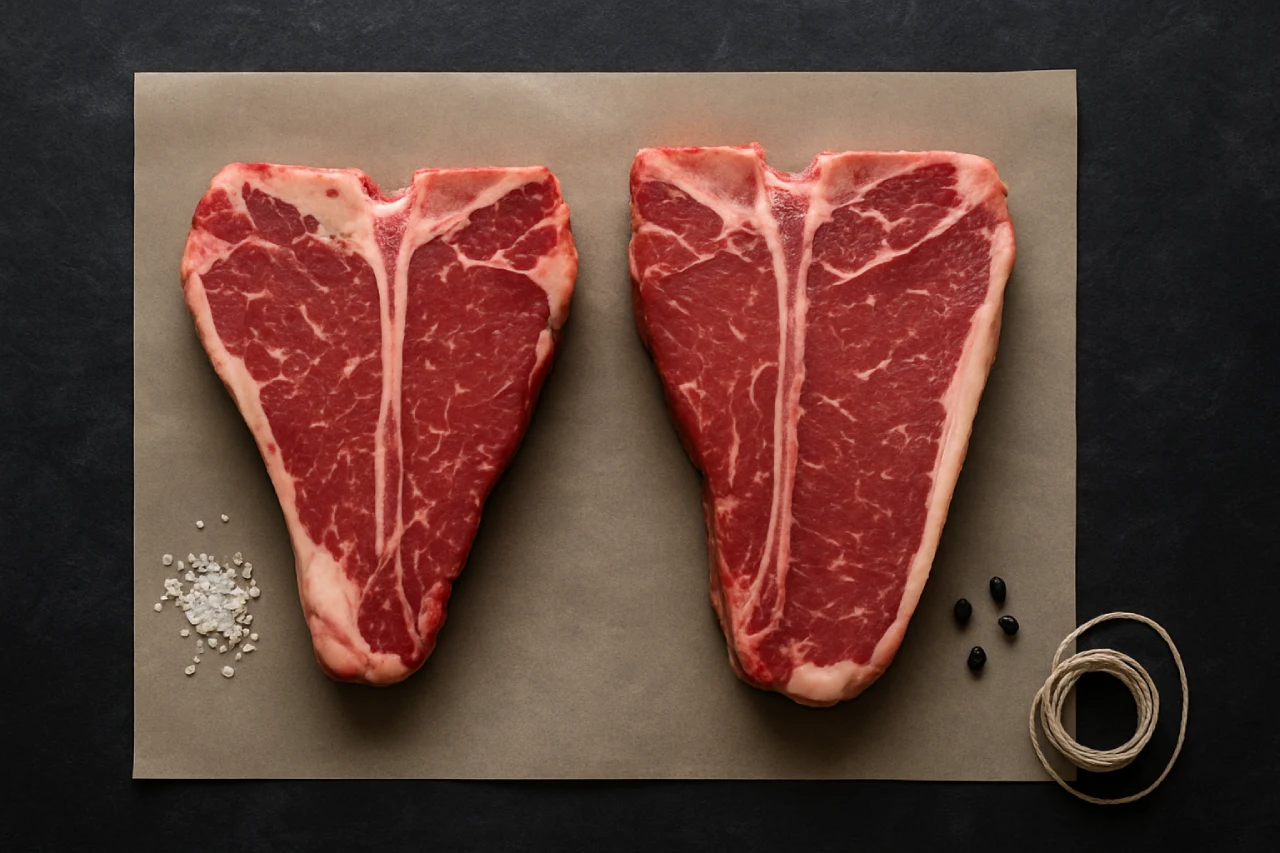
Both T-bone and porterhouse are short loin steaks with a T-shaped bone dividing two steaks in one:
- On one side: the strip loin (New York strip).
- On the other: the tenderloin (filet mignon).
The difference comes down to where the steak is cut and how much tenderloin you get.
TL;DR (Quick Take)
- Porterhouse = cut from the rear short loin with a larger tenderloin. It’s the one often marketed as “for two.”
- T-bone = cut from the front short loin with a smaller tenderloin, still generous strip side.
- U.S. spec: At the widest point of the tenderloin side, porterhouse ≥ 1.25 in (32 mm); T-bone ≥ 0.5 in (13 mm).
- Portions: T-bone commonly 16–24 oz (450–680 g); porterhouse 20–32+ oz (570–900+ g) including bone.
- Cook: Use a two-zone grill or reverse-sear to keep the tenderloin from overcooking.
Anatomy: What’s On Each Side of the “T”
- Strip side (long side): Beefy, moderately marbled, great crust potential.
- Tenderloin side (short side): More tender, leaner, cooks faster.
Where they’re cut:
- T-bone: From the front (anterior) short loin where the tenderloin tapers.
- Porterhouse: From the rear (posterior) short loin where the tenderloin is thick.
In plain English: all porterhouses are T-bones, but not all T-bones qualify as porterhouse.
Portion Sizes (What Feeds Whom)
| Steak | Typical Thickness | Common Weights* | Feeds |
|---|---|---|---|
| T-bone | 1–1½ in (2.5–4 cm) | 16–24 oz (450–680 g) | 1 hungry adult (or 2 light eaters) |
| Porterhouse | 1¼–2 in (3–5 cm) | 20–32+ oz (570–900+ g) | 2 adults (classic “for two”) |
*Includes bone. The bone accounts for roughly 15–25% of the total weight depending on cut.
Buying tip: For shareable steaks, target 1½–2 inches thick so you can nail crust and doneness without overcooking the tenderloin.
Cooking Strategy (Don’t Overdo the Tenderloin)
Best overall: Two-zone fire (or reverse-sear).
- Start on the cool/indirect side to bring the center up gently.
- Finish with a hard sear over direct heat for crust.
- Keep the tenderloin farther from the hottest zone whenever possible.
Pull temps (instant-read thermometer):
- Rare 120–125°F (49–52°C)
- Medium-rare 130–135°F (54–57°C)
- Medium 140–145°F (60–63°C)
Rest 5–10 minutes.
Food-safety note: USDA guidance for whole-muscle beef is 145°F/63°C with a rest.
Which One Should You Buy?
- Want more filet on the plate or sharing for two? Go porterhouse.
- Want a big steak with a bit of filet and a huge strip side, usually a bit cheaper? Go T-bone.
- Value play: A thick T-bone often costs less per pound than a porterhouse while still giving you both experiences.
Carving at the Table (Easy Wow Factor)
- Run a knife along both sides of the T-bone to separate strip and tenderloin.
- Slice each muscle across the grain into strips.
- Reassemble against the bone for presentation, then serve with flaky salt or a spoon of compound butter.
Buying Checklist
- Spec matters: In U.S. markets, a porterhouse should show a big, clearly wider tenderloin.
- Thickness: Aim for 1¼–1½ in minimum; 2 in is perfect for sharing.
- Marbling: Fine, even flecks across the strip face.
- Packaging: Bright color, minimal purge, tidy trim around the bone.
Price & Value
- Porterhouse often commands a premium because you’re getting a sizable tenderloin plus the strip.
- T-bone can be a better cost-to-meat ratio, especially if you love the strip side most.
Frequently Asked Questions
Is porterhouse just a bigger T-bone?
Pretty much—bigger tenderloin side by definition. It’s cut farther back on the short loin.
Why does my porterhouse cook unevenly?
The tenderloin cooks faster than the strip. Use two-zone heat or reverse-sear and position the tenderloin away from the hottest spot.
Can I separate the steak before cooking?
You can, but you’ll lose the bone-in flavor and presentation. If you do, cook the strip and tenderloin to their ideal temps separately.
What’s a good sharing size?
A 1½–2 in porterhouse (28–36 oz / 800–1000 g) comfortably serves two with sides.
Which is more tender?
The tenderloin (filet) side is more tender; the strip side is beefier with a firmer chew.
Why are bone-in steaks pricier per pound?
You’re paying for bone weight and often premium center-cut positioning. The eating experience (flavor, presentation) is the trade-off.
Does bone make it cook slower?
Slightly near the bone. Plan for a touch more time, and rely on a thermometer, not the clock.
What’s the ideal doneness?
Many prefer medium-rare (130–135°F / 54–57°C) to keep the tenderloin luscious and the strip juicy.
Final Tip
If you can choose your exact cut, ask for a steak from the rear third of the short loin—that’s where true porterhouses live, with the most generous tenderloin.