Now shipping nationwide • Free guides & recipes

Slang Words for Steak: A Butcher–Chef–Backyard Glossary

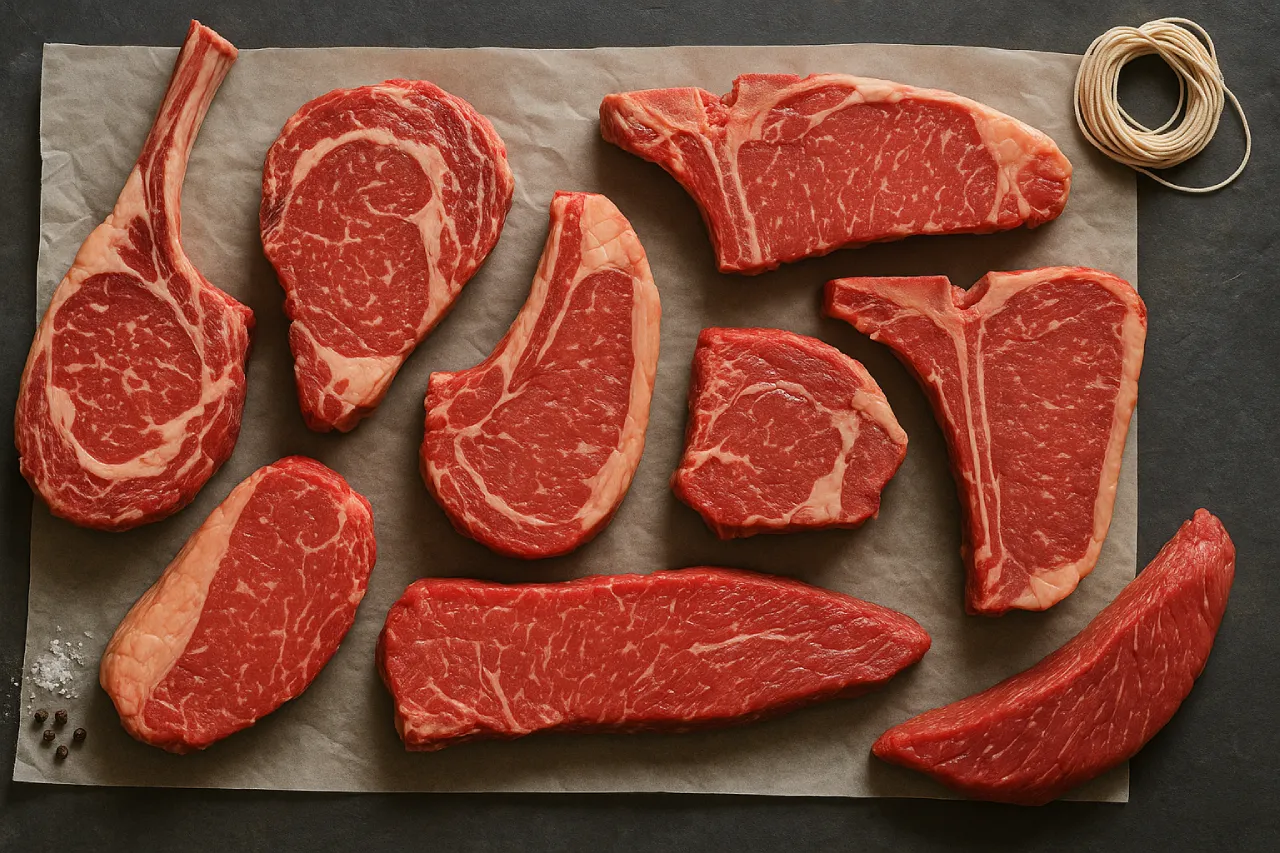
Steak slang is a mash-up of butcher nicknames, regional terms, and old-school restaurant jargon. This guide decodes the most common (and often confusing) names you’ll hear at butcher counters, steakhouses, BBQ joints, and around the grill.
Quick note: Many nicknames are regional or historical. When in doubt, ask for the primal/cut name (“boneless ribeye,” “strip loin,” “top sirloin cap,” etc.) to avoid surprises.
Cut Nicknames & Regional Terms (Cheat Sheet)
| Slang / Nickname | What It Actually Is | Where You’ll Hear It | Why It’s Called That |
|---|---|---|---|
| Delmonico | Historically variable: often ribeye or top loin (strip) | U.S. (Northeast; menus) | Named after Delmonico’s restaurant; usage varies—ask the butcher |
| Scotch fillet | Boneless ribeye | Australia, NZ (sometimes UK) | Regional name for ribeye |
| Spencer steak | Boneless ribeye | U.S. (West Coast) | Regional market name |
| Beauty steak | Ribeye with striking marbling | U.S. (butcher slang) | Looks beautiful on the tray |
| Cowboy steak | Bone-in ribeye (short “frenched” bone) | U.S. steakhouses | Western presentation |
| Tomahawk | Long-bone ribeye (extra-long frenched bone) | U.S., global | Bone resembles a handle |
| Shell steak | Bone-in New York strip | U.S. (Northeast) | “Shell” = bone section of short loin |
| Kansas City strip | Usually bone-in strip; NY strip is often boneless | U.S. (Midwest) | Regional naming split |
| Sirloin (UK) | U.S. strip (short loin) | UK, EU | UK “sirloin” ≈ U.S. strip loin |
| Entrecôte | Ribeye (boneless) | France, EU | “Between the ribs” |
| Contre-filet | Strip loin | France | Opposite side of the loin from filet |
| Bife de chorizo | Strip steak | Argentina | Local name (not the sausage) |
| Eye fillet / Fillet steak | Tenderloin (filet mignon for medallions) | AUS/NZ (eye fillet), UK (fillet) | Regional terms |
| Chateaubriand | Center-cut tenderloin roast, not a single steak | Classic French menus | Served for two |
| Porterhouse | Large T-bone with big tenderloin side | U.S., global | Cut from rear short loin |
| T-bone | Bone-in strip + smaller tenderloin | U.S., global | Cut slightly forward of porterhouse |
| Club steak | Bone-in strip from the front short loin | U.S. (older menus) | Clubby steakhouse classic |
| Ribeye cap / Spinalis / Calotte | The cap muscle of ribeye | U.S./FR | Highly marbled, prized |
| Picanha | Top sirloin cap (rump cap) | Brazil (global now) | Skewered as “espeto” |
| Coulotte / Culotte | Top sirloin cap | U.S. | Americanized French name |
| Tri-tip | Bottom sirloin triangle | U.S. (California) | Santa Maria specialty |
| Bavette | Flap steak (sirloin flap) | France/US | Great marbling, loose grain |
| Onglet | Hanger steak | France/US | “Butcher’s steak” (they kept it) |
| Arrachera | Skirt steak (for fajitas) | Mexico/US | Marinated, grilled, sliced |
| Flat iron | Top blade steak (chuck) | U.S., UK (“butler’s”), AUS (“oyster blade”) | Modern cut from shoulder |
| Denver / Zabuton | Chuck underblade steak | U.S. / Japan (wagyu) | Tender, nicely marbled |
| Baseball steak | Thick center-cut top sirloin | U.S. | Puffs like a baseball when seared |
| Minute steak | Very thin, fast-cooking steak | Global | “A minute” per side |
| Cube steak | Tenderized (mechanically) round/steak | U.S. diners | Dimpled from cubing—chicken-fried |
| London broil | Technique, not a cut (often flank/top round) | U.S. | Marinate, broil/grill, slice thin |
Doneness & Technique Slang
- Blue / Bleu: Very rare, cool center.
- Black and blue / Pittsburgh: Charred exterior, rare/very rare interior.
- Chicago-style: Deep char outside; rare-to-medium inside (varies by house).
- Pittsburgh “char”: Aggressive crust from extreme heat or cast-iron.
- Reverse-sear: Low/indirect to near target, then blazing hot sear.
- Two-zone fire: Hot (direct) + cool (indirect) zones on the same grill.
- Kiss the grate: Brief sear for color without cooking through.
- Resting / Carryover: Temp rises a few degrees off heat as juices redistribute.
Safety note: USDA guidance for whole-muscle beef is 145°F (63°C) with a rest. Many steak lovers prefer lower pull temps for quality—choose based on your preference and risk tolerance.
How to Order Without Confusion
- State the cut clearly (“boneless ribeye,” “bone-in strip”).
- Add thickness (e.g., 1¼–1½ in / 3–4 cm).
- Specify doneness by temperature if possible (e.g., “pull at 130–135°F / 54–57°C”).
- If you say a nickname (Delmonico, Kansas City, shell steak), follow with the standard cut to confirm.
Mini-Dictionary (One-Liners)
- Deckle: Often means ribeye cap (spinalis), but some BBQ folks use it for the brisket point—context matters.
- Cap-on/off: Whether a cut retains its fat/muscle cap (e.g., ribeye cap, sirloin cap).
- Frenched: Bone scraped clean for presentation (tomahawk, cowboy).
- Prime rib: A standing rib roast; when sliced into steaks it’s ribeye.
- Butcher’s steak: Hanger (onglet)—so tasty but once rare on menus.
- Santa Maria steak: Tri-tip grilled over red oak, sliced against grain.
How Slang Changes by Country (Fast Map)
- U.S.: Ribeye/NY strip/T-bone/porterhouse common; “Delmonico,” “cowboy,” “tomahawk” pop up on menus.
- UK: “Sirloin” ≈ U.S. strip; “fillet” = tenderloin; ribeye often called ribeye.
- Australia/NZ: “Scotch fillet” (ribeye), “eye fillet” (tenderloin), “rump cap” or “picanha.”
- France: “Entrecôte” (ribeye), “contre-filet” (strip), “onglet” (hanger), “bavette” (flap).
- Latin America: “Bife de chorizo” (strip), “picanha” widely recognized, “arrachera” (skirt).
Frequently Asked Questions
Is “Delmonico” a ribeye or a strip?
Both—historically variable. Some use it for ribeye, others for top loin (strip). Always confirm the cut.
What’s the difference between a tomahawk and a cowboy steak?
Both are bone-in ribeyes. Tomahawk has an extra-long frenched bone; cowboy has a shorter frenched bone.
Are “sirloin” and “strip” the same thing?
In the UK/EU, “sirloin” is the strip loin. In the U.S., sirloin usually means top/bottom sirloin, a different section. Clarify by primal.
Is “London broil” a cut?
No—it’s a method (marinate, broil/grill, slice thin). Butchers label various lean cuts “London broil.”
What is “picanha” called in the U.S.?
Top sirloin cap (aka coulotte/culotte). Look for the fat cap intact.
What’s “black and blue” vs. “blue”?
Blue is very rare/cool center. Black and blue (Pittsburgh) is charred outside with a rare/very rare center.
Is “baseball steak” filet mignon?
No—usually a thick center-cut top sirloin that puffs up when seared.
Does “prime rib” mean USDA Prime grade?
Not necessarily. “Prime rib” refers to the cut/roast, not the USDA grade. You can have Choice-grade “prime rib.”
Is “bavette” the same as flank?
Different muscles; bavette is flap (sirloin flap), looser grain and great marbling. Flank is leaner, tighter fibers.
What’s “shell steak”?
A bone-in strip (short loin). “Shell” refers to the bone/shell section it’s attached to.
Pro Tip Before You Hit “Order”
If you see a nickname on the board, ask, “Is that boneless ribeye (scotch fillet) or strip loin?” A 5-second clarification saves a 50-minute disappointment.